
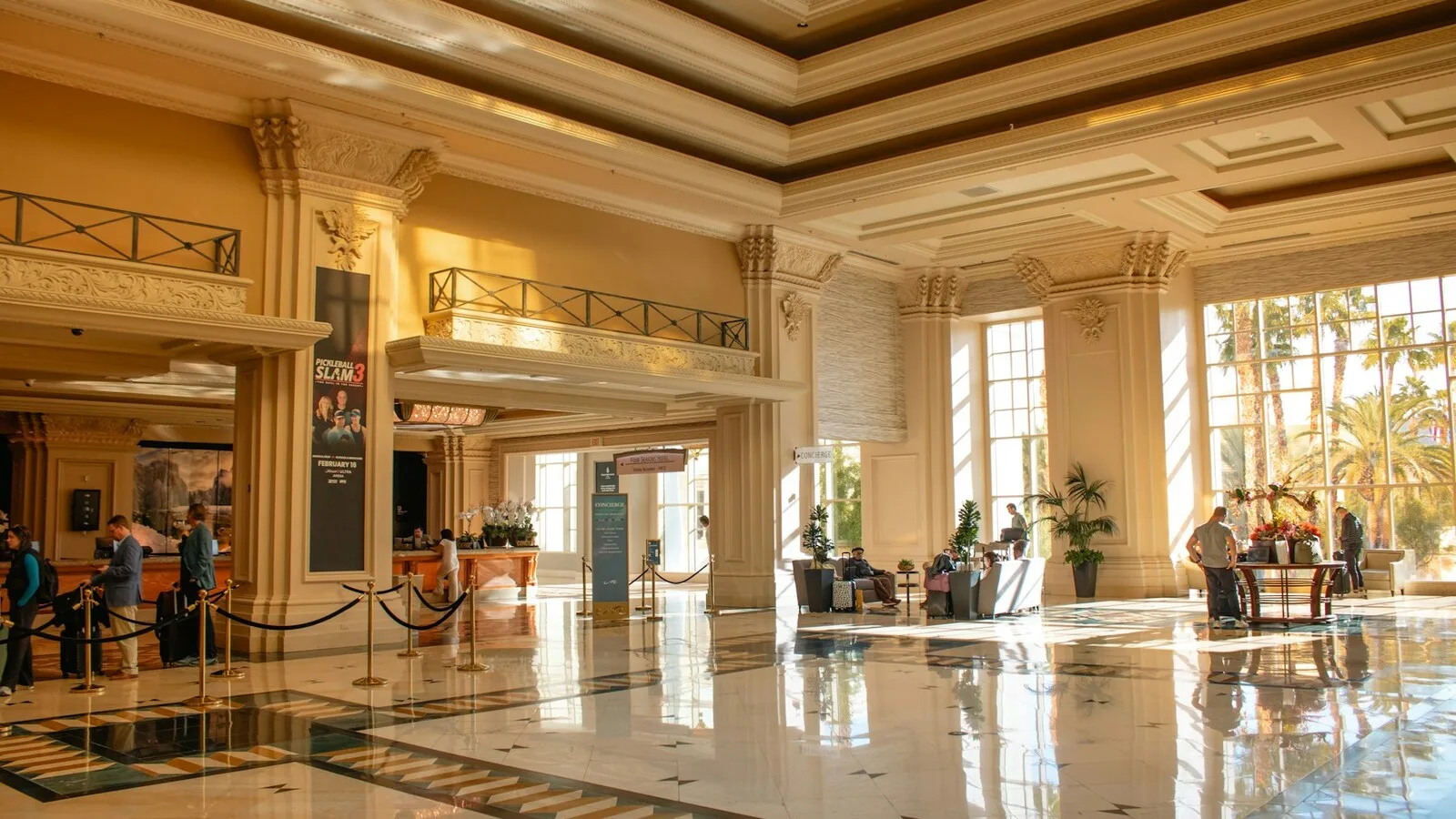
Most hotel camera systems are specified for the wrong building. They are drawn as though the property were a large office with a public entrance, when a hotel is a public building that people sleep in. That one difference decides where cameras belong, how long footage is kept, and which recordings turn out to be a liability rather than an asset.
The problem in this industry
Hospitality carries a documented risk profile, and it carries several of the risk factors at once. The Occupational Safety and Health Administration lists working late at night, working in areas with high crime rates, providing services and care, and working where alcohol is served among the conditions that raise the likelihood of workplace violence. A hotel with a 24 hour front desk, a bar and a lone night porter has all four. The scale is not trivial: of the 5,283 fatal workplace injuries recorded in the United States in 2023, 740 were due to violent acts, and 458 of those were homicides.
Against that sits a constraint no other building type has in the same form. Guests accept cameras in a lobby and resent them almost everywhere else, and the resentment is not irrational. A corridor camera that can see into a room when the door opens is a different object from a corridor camera that cannot, even though both appear on the same drawing as a dot in a hallway.
The third complication is who is actually in the building. A hotel shares its floors with agency housekeeping, contractors, event attendees, delivery drivers and people who walked in off the street to use the bar. Access control tells you who opened a door. Video tells you who went through it. Neither answers the question on its own, which is why the two are usually specified together and separately reviewed. That relationship is covered in video surveillance and access control.
Where the coverage argument usually goes wrong
- Cameras framed for the room, not the face. A wide lobby shot proves someone was present. It rarely proves who. Identification needs a chosen line people have to cross, at a height and angle set for a face.
- Back of house left out. The loading bay, the laundry, the staff entrance and the key cabinet are where property actually leaves a hotel, and they are the areas most often cut when the camera count is trimmed.
- Microphones left enabled. Most IP cameras ship with audio on. See below, because this is a legal question and not a preference.
- Retention set by whatever the recorder held. A guest who disputes a charge three weeks later meets a system that kept seven days, and the footage argument is lost before it starts.
How the capability applies
The workable approach is to stop drawing cameras and start drawing zones, then decide separately what each zone is for. Four zones cover a hotel.
- Public areas. Lobby, reception, bar, restaurant, retail. Cameras here are for identification at the points people must pass, and for the operational picture described further down.
- Transition points. External doors, lift lobbies, stairwell doors and the doors between front and back of house. These earn their cost several times over, because everyone who reaches a guest floor passed through one of them.
- Guest floors. Corridors, positioned so a person is identifiable and a room door is attributable, framed so the interior of a room is not in shot when the door opens.
- Back of house. Loading, storage, laundry, plant, cash handling and the key cabinet.
And a list of places where no camera goes, which belongs in the specification rather than in a policy nobody reads: guest rooms, bathrooms, changing areas, pool changing rooms, treatment rooms, and staff welfare areas. Writing the exclusions down is what makes them survive the second phase of the project.
Audio is a different legal question from video
A camera with a live microphone is not a video system with a bonus feature. Federal wiretap law at 18 U.S.C. 2511 makes it an offense to intentionally intercept an oral communication, subject to specific exceptions including where a party to the communication has given prior consent. States add their own rules, and several require the consent of every party rather than one. The practical position for a hotel is to disable microphones unless there is a specific, advised reason to run them and a notice regime to match. The wider position on notice and recording is set out in recording, privacy and the law.
Facial recognition deserves a flat answer
Face matching to greet a returning guest is sold as hospitality and behaves as biometrics. NIST evaluated this directly in NIST IR 8280 and found that error rates are not uniform across demographic groups. That evaluation is from 2019 and algorithms have moved since, but the finding that matters has not gone away: a false match rate quoted as a single number describes an average, not the experience of any particular guest. If a property runs face matching, it is running a system that will be wrong more often for some guests than others, and that is a decision to take deliberately rather than to accept as a feature.
Retention is a decision, not a disk size
NIST SP 800-53 control PE-6 asks organizations to monitor physical access, to review physical access logs at an organization defined frequency and on defined events, and to coordinate the results of those reviews with incident response. The companion habit for records, AU-11, is to retain them for an organization defined period consistent with a records retention policy. Both phrases turn on the same idea. Someone decides the number, writes it down, and can say why. A hotel that cannot name its retention period does not have a retention policy, it has a storage limit.
What changes
The returns that show up in practice are less dramatic than the ones in the business case, and more durable.
- Disputes close. Chargebacks, missing property claims, damage attributed to the wrong guest and slip and fall claims all turn on what happened. Each one settled by footage is a cost not incurred.
- Night shift gets safer. A monitored, well framed reception is a control for the risk factors OSHA lists, alongside staffing, lighting and procedure. It is one control among several and worth describing as such.
- Operations start asking. Queueing at check in, housekeeping routes, loading bay congestion and event flow all become visible. In most properties this is the point at which the system stops being a grudge purchase, and it is almost never in the original justification.
- Investigations get shorter. Retrieval measured in hours rather than days, by more than one trained person, is the difference between a capability and a dependency on whoever knows the recorder.
What does not change is worth stating with the same directness. Cameras do not reduce headcount, and a business case that assumes they will is usually revisited within a year. They do not prevent a countable number of incidents, because the incidents that did not happen leave no record and any figure offered for them was estimated. They do not help at all when retention was too short, coverage stopped at the lobby, or the one person who could export a clip has left.
If you are assessing an existing property, a survey gives you the coverage, retention and camera health baseline the decisions above depend on. Request a free site security assessment. For the wider picture, see the guide to video surveillance, for the sector page see hospitality, and for what we install see our video surveillance solutions.
Sources
- Occupational Safety and Health Administration, Workplace Violence. Establishes the risk factors quoted for hospitality, including working late at night, working in areas with high crime rates, providing services and care and working where alcohol is served, and the 2023 figures of 5,283 fatal workplace injuries, 740 due to violent acts and 458 homicides. osha.gov. Accessed 18 August 2026.
- National Institute of Standards and Technology, SP 800-53 Rev. 5, Security and Privacy Controls for Information Systems and Organizations. Establishes control PE-6, which pairs monitoring physical access with reviewing the logs at an organization defined frequency and coordinating the results with incident response, and control AU-11 on retaining records for an organization defined period. nvlpubs.nist.gov. Accessed 18 August 2026.
- 18 U.S.C. 2511, Interception and disclosure of wire, oral, or electronic communications prohibited. Establishes that intentionally intercepting an oral communication is an offense, and the exception where a party to the communication has given prior consent. law.cornell.edu. Accessed 18 August 2026.
- National Institute of Standards and Technology, NIST IR 8280, Face Recognition Vendor Test Part 3: Demographic Effects (December 2019). Establishes that face recognition error rates are not uniform across demographic groups, which is the accuracy caveat behind any guest recognition feature. nvlpubs.nist.gov. Accessed 18 August 2026.