
Schools and campuses want cameras for a small number of specific reasons and inherit a set of obligations that surprise people, because in education the footage itself can become a student record. Who maintains it, and why, changes its legal status.
The problem in this industry
Surveillance footage can be an education record. The Department of Education states that a photo or video of a student is an education record when it is "directly related to a student" and "maintained by an educational agency or institution or by a party acting for the agency or institution." Its own example is unambiguous: "A school surveillance video showing two students fighting in a hallway, used as part of a disciplinary action, is directly related to the students fighting." Conversely, footage in which a student's image "is incidental or captured only as part of the background" is not directly related.
Who holds it matters. FERPA excludes records created and maintained by a law enforcement unit of an institution for a law enforcement purpose. So if a campus law enforcement unit creates and maintains the surveillance video for that purpose, those videos are not education records. If that unit then provides a copy to another part of the institution, for example to support a disciplinary action, the copy may become an education record. The same footage can therefore sit on either side of the line depending on which department holds which copy and why.
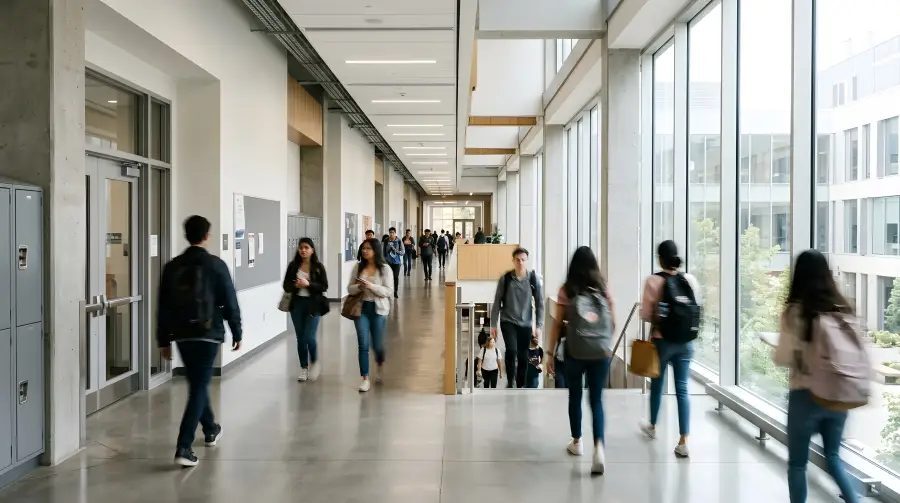
Buildings are open and used by many people. Corridors, entrances, car parks and grounds, with a population that changes every hour and includes minors, staff, contractors and visitors.
Requests will come. Parents, staff, investigators and police all ask for footage, and each request has a different answer. Without a policy, each becomes an individual decision taken under pressure.
How the capability applies
- Cover approaches, entrances and circulation, not learning. Perimeter, car parks, entrances, corridors, stairwells, loading and plant areas. Classrooms, restrooms and changing areas are where surveillance stops.
- Write the purpose per camera before installation. In education this is not only a design aid; it is the record showing placement was considered against the reason for it.
- Decide the custody question deliberately. Which department creates and maintains the footage, and for what purpose, and what happens when a copy is passed to another. That decision has consequences under FERPA, so make it with counsel rather than by default.
- Write a disclosure procedure. Who may request footage, who approves, what is provided, what is logged and how footage containing other students is handled. Almost every difficult moment in a school system is a disclosure question.
- Set retention deliberately. Long enough for incidents to surface and be investigated, short enough that you are not holding a large archive of identifiable minors. NIST treats retention as an organizational decision; here it is also a risk decision.
- Record video, not audio. Microphones in a school raise consent questions that video alone does not. Confirm they are disabled. See recording, privacy and the law.
- Control access by role. Viewing and exporting are separate permissions, and both should be logged. In education the list of people who want access is long and mostly should not have it.
What changes
Incidents are established rather than argued. Corridor and grounds incidents are resolved from a record, which changes both the investigation and the conversation with families.
Disclosure stops being improvised. A written procedure means a request from a parent, an investigator or the police follows a path someone already thought about.
The footage becomes defensible. Stated purposes, documented boundaries, logged access and enforced retention are what let an institution explain its system to a school board, a union or a regulator.
Grounds and out of hours coverage becomes useful. Most campus incidents happen where nobody is standing. Cameras at approaches and car parks are the ones that consistently produce useful footage.
LABUSA works with schools, districts and campuses on systems built around those boundaries. See our education industry page, or request a free site security assessment. For the installation sequence, see how to plan a video surveillance installation, and for what we install our video surveillance solutions.
This page describes federal guidance in general terms and is not legal advice. How FERPA applies to your institution is a question for your counsel.
Sources
- U.S. Department of Education, Student Privacy Policy Office, FAQs on Photos and Videos under FERPA. Establishes the two-part test quoted here, the surveillance video example, the treatment of incidental images, and the law enforcement unit exclusion including what happens when a copy is provided to another component of the institution. studentprivacy.ed.gov. Accessed 18 August 2026.
- National Institute of Standards and Technology, SP 800-53 Rev. 5, Security and Privacy Controls for Information Systems and Organizations. Establishes that video retention periods are organization-defined rather than fixed. nvlpubs.nist.gov. Accessed 18 August 2026.