
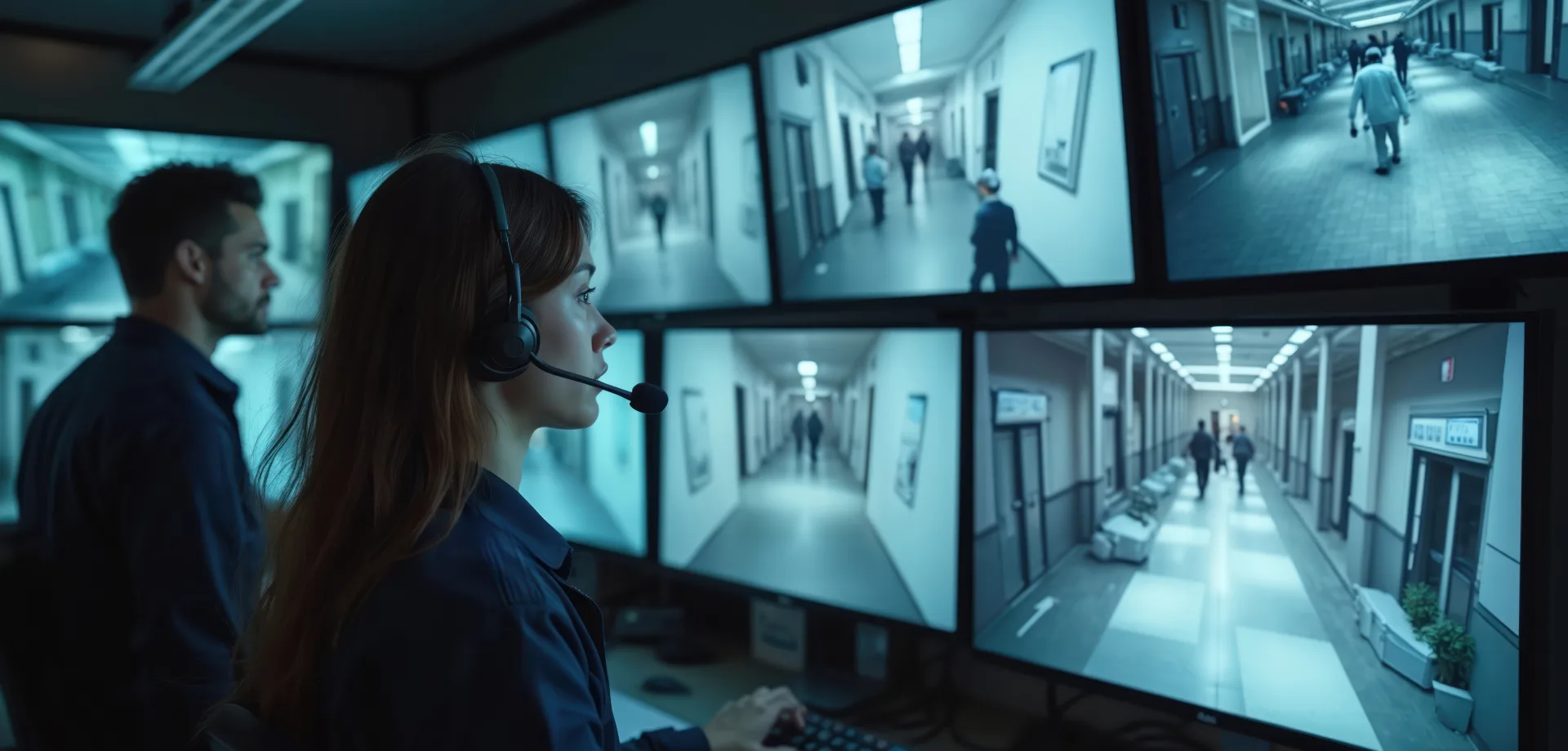
The term covers everything from a single doorbell camera to a campus system with hundreds of streams, which is why quotes for "video surveillance" vary so widely. This page sets out what the words actually mean, so you can tell what a proposal includes and what it quietly leaves out.
Definition
Video surveillance is the recording of activity in defined areas so that it can be reviewed later, and in some cases watched live. The important half of that sentence is "so that it can be reviewed later." A camera that produces an image nobody can search, export or keep long enough to use is not performing surveillance in any useful sense.
Federal guidance frames it the same way. NIST SP 800-53 describes video surveillance as employing cameras over defined operational areas, reviewing recordings at a defined frequency, and retaining them for a defined period. It also notes plainly that "monitoring the surveillance video is not required," which is worth knowing before anyone quotes you for staffed monitoring you may not need.
What it includes
A complete system has five parts. A quote that omits one of them is not cheaper, it is incomplete.
- Cameras. Fixed or pan-tilt-zoom, indoor or outdoor rated, with a lens and sensor chosen for the distance and lighting of the specific view. The useful measure is not megapixels but pixels across the thing you need to recognize.
- Cabling and power. Most cameras today take data and power over one cable. This is the physical infrastructure of the system and the part that decides where a camera can go. See how the cabling constrains the design.
- Recording and storage. A network video recorder on site, a cloud subscription, or a hybrid of the two. See the cloud and on-premise comparison.
- Video management software. Live view, timeline search, motion or object search, user accounts, permissions, and export. This is what your staff actually touch.
- Policy and people. Who may look, who may export, how long footage is kept, and who responds. Unglamorous, and the part that determines whether the system helps you on the day it matters.
Analytics, which sit on top
Motion detection, line crossing, people counting, license plate recognition and face recognition are features of the software or the camera rather than separate systems. They vary enormously in maturity, and their accuracy is a property of the specific product and the specific scene, not of the category. Treat any analytics claim as something to be demonstrated on your own site.
What it is not
It is not access control. Cameras record what happened; access control decides who may open a door. They answer different questions and are frequently confused in requirements documents. They work considerably better together, which is the subject of video surveillance and access control.
It is not an alarm system. A camera does not summon anyone. Detection and response come from intrusion detection, staffing or a monitoring service. See video surveillance and intrusion detection.
It is not audio recording, and you should be deliberate about keeping it that way. Many cameras include a microphone, and enabling it moves you into a different area of law. Federal wiretap law addresses the interception of oral communications: 18 U.S.C. 2511 provides that it is not unlawful for a person not acting under color of law to intercept an oral communication where that person is a party to it, or "where one of the parties to the communication has given prior consent," unless the interception is for a criminal or tortious purpose. State law is not identical to federal law and several states are stricter, so audio is a question to put to counsel before it is a question to put to an installer. Most organizations disable microphones and record video only. Recording, privacy and the law covers this in more detail.
It is not a set of appliances you can ignore. Every camera is a networked computer. NIST publishes a core baseline of the cybersecurity capabilities such a device should have: device identification, device configuration, data protection, logical access to interfaces, software update and cybersecurity state awareness. Cameras that cannot be updated or cannot restrict access to their own interfaces are a standing risk on your network, covered in video surveillance security and risk.
Who needs it
Video surveillance earns its place where at least one of the following is true.
- You have areas where an incident would be disputed. Entrances, cash handling, loading docks, parking, stock rooms. The value is in settling the question, and that requires image quality and retention chosen with that in mind.
- You have obligations about physical access. Regulated organizations frequently have to show that access to certain areas is controlled and monitored, and video is one of the accepted methods.
- You have sites nobody is standing in. Remote, out of hours, or simply too large to watch. Recording is the only practical form of coverage.
- You need to understand a process, not just police it. Where an operational question keeps recurring, footage answers it.
If none of those apply, a smaller system aimed at one problem is usually the better purchase. If several do, start with the full guide, then the buyer checklist.
To find out which of these apply to your building rather than in general, request a free site security assessment. LABUSA will walk the site and document what each area needs. You can also read about our video surveillance solutions.
Sources
- National Institute of Standards and Technology, SP 800-53 Rev. 5, Security and Privacy Controls for Information Systems and Organizations. Establishes the description of video surveillance used here: employing cameras over defined areas, reviewing recordings at a defined frequency, retaining them for a defined period, and that monitoring live video is not required. nvlpubs.nist.gov. Accessed 18 August 2026.
- Legal Information Institute, Cornell Law School, 18 U.S.C. 2511. Establishes the federal consent provision quoted here for the interception of oral communications. law.cornell.edu. Accessed 18 August 2026.
- National Institute of Standards and Technology, IR 8259A, IoT Device Cybersecurity Capability Core Baseline. Establishes the six device cybersecurity capabilities listed. nvlpubs.nist.gov. Accessed 18 August 2026.